

The Online News Act has been widely considered a complete and total failure. It seems rescinding it is a possibility.
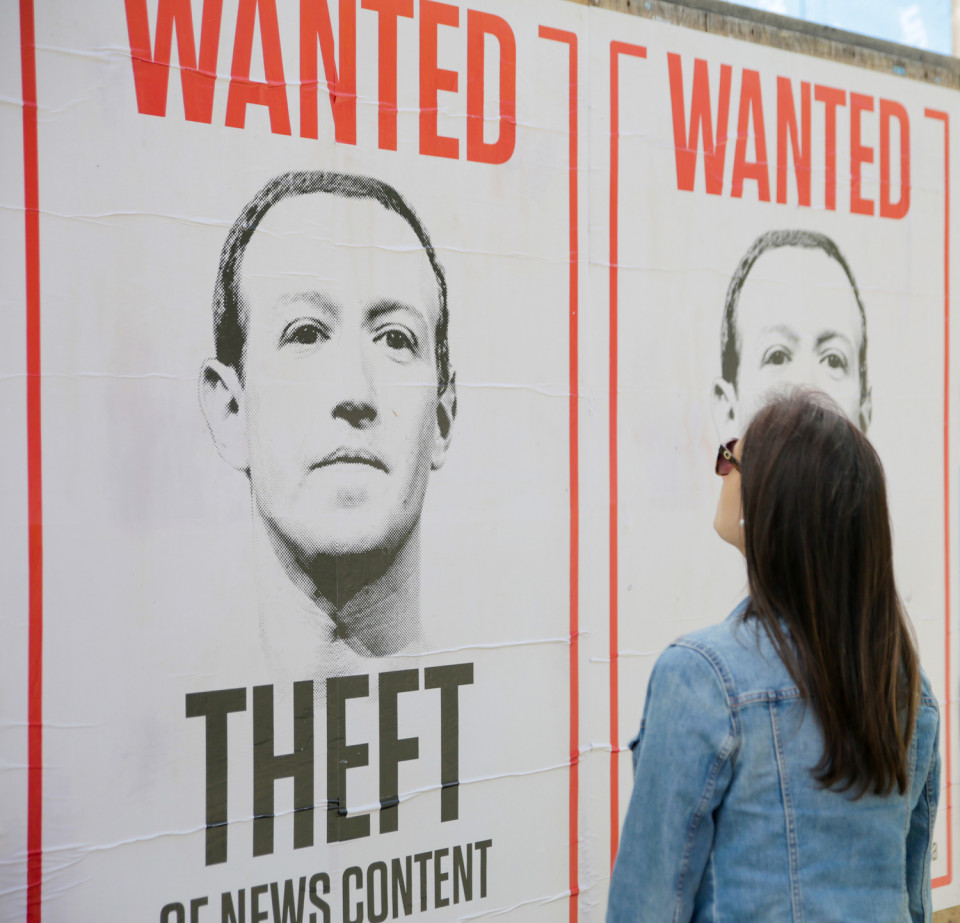
The Online News Act was built on lies with the structural integrity of a house of cards. Among those lies was the notorious Big Lie 1.0 which said linking is stealing and that the Online News Act was about ‘compensating journalists for their work’. Obviously, if you have even the slightest shred of knowledge on how social media works, you’ll know that it’s the news organizations themselves posting their links to these platforms with the hopes of reaching as many eyeballs as possible, increasing web traffic to their websites which would lead to a broader reach and better profit. That, of course, didn’t stop mainstream media from pushing this lie anyway, going so far as to post fake wanted posters claiming that Mark Zuckerberg of Facebook, was “stealing” news content.
Naturally, Facebook responded by pointing out that they don’t depend on Canadian news content for their survival. The mainstream media responded by doubling down on their blatant lies and cherry picked statistics by declaring that without Canadian news links, Facebook would practically shut down overnight because without news links, no one would have anything to talk about (insert audience laughter here). So, after Meta understandably threw their hands up in the air over this ridiculous situation and said that they will be blocking news links, the mainstream media panic. They saw their lies already crashing down. In response, they rolled out the also notorious Big Lie 2.0 which said that Facebook is censoring media. In the process, the Canadian mainstream media was burning through their credibility at a breathtaking pace, earning themselves a reputation of being propaganda rags rather than being serious journalism outlets. Either way, Meta began blocking news links on Facebook and Instagram, wiping out $230 million in value for all general publishers in Canada.
While that was happening, Google was contemplating doing the same thing – removing all Canadian news links from their services. Indeed, Meta dropping news links put the entire sector onto life support, but a Google pullout would likely mean a death sentence for that sector. This put the Canadian government in a huge panic and, as a result, the government surrendered everything to Google in a last ditch effort to try and appease the tech giant. Google rolled up all existing deals into a $100 million per year package – meaning that the dollar value was by no means all new money – and agreed not to delist Canadian news sources from their services. It was what Google proposed all along and, well, they got it.
The Canadian mainstream media, being the pathological liars that they were on this story, spent months spinning this whole thing up as some sort of win. The proclaimed that the $100 million was a massive victory, pretending that this was all new money when it factually was not. What’s more, they went so far with their lies by arguing that Meta would be so overcome with jealousy that they would come crawling back to them to work out a deal any day now. That, of course, was about two years ago and for reasons that should be obvious, that never happened.
Of course, the damage the mainstream media brought on themselves was severe. When this law was still a bill, they argued that this was a financial solution for an ailing industry that would not cost taxpayers a single penny. Of course, this law was a massive mistake and the government wound up issuing a massive bailout, costing Canadian taxpayers hundreds of millions to cover up the mistake that they made of pushing for this link tax law in the first place. While that short term solution seemed like a good one for the major media outlets that foolishly pushed this law in the first place, it proved to be the start of a whole pile of problems.
For one, he perception of the mainstream media changed for the worse. Instead of being the whatever estate that they are (depending on the medium), holding power to account, the major media outlets became heavily subsidized by the state, becoming what amounts to state funded media. Journalists would become far more hesitant to hold power to account now that their paycheck depends on government. In fact, there have already been at least one instance where the government threatened to pull money from an outlet for daring to publish a politically inconvenient story. That demonstrated the overwhelming power government has over Canadian media outlets these days.
While the independence of the press is highly questionable these days, that wasn’t the only problem. Over and above the threatened lawsuits, the passage of the Online News Act also infuriated the US government – both the Biden administration and the Trump regime. This resulted in numerous warnings and letters because the law (one of three, in fact) violates CUSMA/USMCA. In fact, the US went even further by initiating a trade dispute consultation in order to initiate a trade challenge against Canada over this, the Online Streaming Act, and the Digital Services Tax. This was also made clear when all three were listed as trade barriers by the US.
Amidst high tension trade talks, the US abruptly ended those talks saying that continued negotiations hinged on the rescinding of the Digital Services Tax. This forced Prime Minister, Mark Carney, to do the right thing and rescind that law. As a result, Canadians were informed that they would be getting refunds if they got charged those taxes. One bad policy down, two to go.
While it is no secret that the Online News Act and Online Streaming Act were continued trade irritants for the US, it wasn’t clear when they’d enter into the picture in all of this. Well, recent reports are suggesting that the Online News Act could be the next bad digital law to go. This as the reports indicate that Carney is suggesting that he is contemplating rescinding it. From Mobile Syrup:
Prime Minister Mark Carney is considering replacing or rescinding the Online News Act.
Carney suggested that his government was considering the move while speaking in West Kelowna, B.C., about a loan and other supports for the softwood lumber industry. Per the National Post, Carney was asked about the Online News Act — also known as Bill C-18 — and Carney said that rescinding the legislation was “part of our thinking.”
The core concern is around the bill’s impact on local news, particularly as it limits the reach of news during critical times, such as the ongoing wildfire crisis. Because of the Online News Act, Facebook owner Meta banned sharing news articles on its platform, which has reduced the reach of news organizations.
“This government is a big believer in the value of … local news and the importance of ensuring that that is disseminated as widely and as quickly as possible. So, we will look for all avenues to do that,” Carney said.
In a vacuum, this sounds like this is just Carney considering it totally on his own. With context, however, there is an open question as to whether or not this is actually being done under pressure from the US. Carney was earlier hinting that he could drop counter tariffs against the US. This after the August 1st deadline came and went without a deal, resulting in the tariffs rising from 25% to 35% on all non-CUSMA/USMCA compliant goods being sent to the US. So, whether this is just Carney suddenly having a change of heart all on his own about the law or a hint that he is facing more pressure from the US to rescind the law remains open for debate. What we do know is that since the Act became law, news outlets have been shutting down a and declaring bankruptcy ever since, resulting in a trail of journalistic destruction.
So, whether this is a sudden change of heart or Carney getting faced with pressure from the US, the rescinding of the Online News Act would most certainly be welcome. While Carney would have a hard time undoing the self inflicted business carnage that has been unleashed on the sector, rescinding the law would at the very least slow that destruction down.
Drew Wilson on Mastodon, Twitter and Facebook.
Discover more from Freezenet.ca
Subscribe to get the latest posts sent to your email.

Now consider rescinding online streaming act or amend to implement section 4.2 (or whatever), that exempt social media user content.
The Online Streaming Act getting rescinded before the damage fully hits would be excellent. Trying to make an impact on social media is darn near impossible already and the last thing creators need is a government actively trying to thwart their efforts at success simply because the CBC or Global needs a few more million views to round out a budget.
The fact that the Online News Act being rescinded is even a possibility was seemingly an unlikely scenario just a year ago. Seeing this faint traces of hope trickling in on something is definitely a nice change. Let’s hope the Online Streaming Act and Online News Act go the way of the Digital Services Tax.